

 By
By New York’s AI Reckoning: The Hidden Cost of Replacing Humans
From corporate boardrooms to neighborhood businesses, artificial intelligence is rapidly changing how work gets done. But as companies race toward automation, many experts are asking whether replacing human workers truly saves money, or simply shifts the cost elsewhere.
The Debate Behind Every Algorithm
Artificial intelligence is everywhere.
It writes emails, answers customer questions, analyzes data, generates content, and increasingly performs tasks once handled by human employees. Across New York, businesses are investing heavily in AI technologies designed to improve efficiency and reduce operational costs.
Executives praise AI for its speed. Investors celebrate its scalability. Technology companies promise a future where productivity reaches unprecedented levels.
Yet behind every AI system replacing a worker lies a question that has become one of the most controversial debates of the modern economy.
What is the real cost of replacing humans? For some, AI represents innovation and progress.
For others, it represents uncertainty, job displacement, and a future where human value is increasingly measured against machines.
The discussion is no longer about whether AI will transform society. The transformation is already happening. The real debate is about who benefits and who pays the price.
Before Artificial Intelligence: How Technology Changed Work
Long before AI entered the workplace, technological revolutions repeatedly reshaped the labor market.
The Industrial Revolution replaced manual labor with machinery. Assembly lines transformed manufacturing. Computers automated administrative work. The internet disrupted entire industries.
Every major technological shift created both opportunities and fears.
Workers worried about losing jobs. Businesses pursued greater efficiency. Governments struggled to adapt regulations to changing economic realities.
History shows that technology rarely eliminates work entirely. Instead, it changes the nature of work itself.
New jobs emerge while older roles disappear. The challenge has always been managing the transition.
Artificial intelligence may be the most significant workforce disruption since the arrival of the computer age because it extends beyond physical labor into cognitive tasks once considered uniquely human.
That distinction makes today’s debate fundamentally different.
Why Businesses Are Embracing AI
The appeal of AI is easy to understand.
Businesses operate in increasingly competitive environments where efficiency often determines survival. Artificial intelligence offers several advantages.
Lower Operating Costs
AI systems can handle repetitive tasks without salaries, benefits, paid leave, or office expenses.
Faster Productivity
Work that once required hours can often be completed within minutes.
Continuous Availability
Unlike human employees, AI systems operate twenty-four hours a day without interruption.
Scalable Growth
Companies can expand AI-powered operations much faster than recruiting, training, and managing large teams.
For business leaders facing rising expenses, the financial argument appears compelling. The promise of doing more with less has become one of AI’s strongest selling points. But focusing solely on cost savings may overlook broader consequences.
When Efficiency Comes at a Human Cost
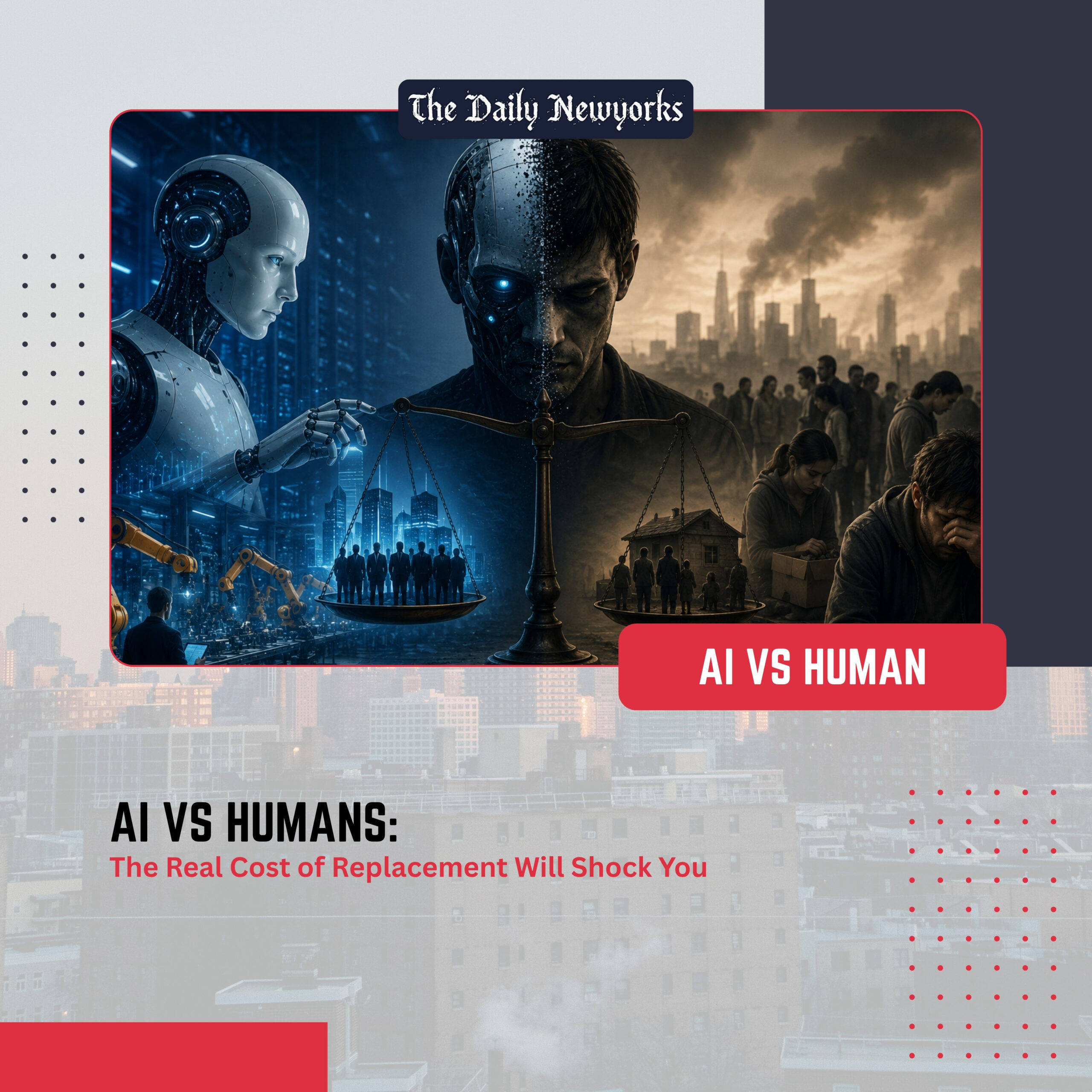
The image of AI replacing human workers often centers on economics.
The reality is far more personal. Behind every job affected by automation is a person, a family, and a community.
- A customer support representative
- A content writer
- An administrative assistant
- A data entry specialist
- For many workers, employment represents more than income
- Work provides stability
- Work creates identity
- Work offers opportunities for growth, connection, and purpose
When jobs disappear, the effects often extend beyond company balance sheets.
Reduced household income impacts local businesses. Communities experience economic strain. Workers face uncertainty while attempting to adapt to rapidly changing skill requirements.
These costs rarely appear in quarterly earnings reports.
Yet they remain part of the broader social equation.
The Value Humans Still Bring
One of the most important aspects of the AI debate is understanding that efficiency is not the same as value.
Humans contribute qualities that remain difficult to automate.
Empathy
People understand emotions, context, and human experiences in ways machines still struggle to replicate.
Creativity
While AI can generate ideas, genuine innovation often emerges from human curiosity, collaboration, and lived experience.
Judgment
Complex decisions frequently require ethical reasoning and situational awareness that extend beyond data.
Relationships
Businesses are ultimately built on trust, and trust remains deeply human.
Many organizations adopting AI are discovering that customers still value authentic human interaction, especially during important or emotionally sensitive situations.
The future may depend less on replacing people and more on enhancing their capabilities.
New York’s Workforce Faces a New Reality
Few cities illustrate the AI transition better than New York.
The city has always adapted to economic change. Manufacturing gave way to finance. Finance expanded into technology.
Now artificial intelligence is reshaping industries across every borough. Wall Street firms use AI for market analysis.Media companies use AI for content creation. Retailers use AI to predict consumer behavior.
Customer service departments increasingly rely on automation. The opportunities are significant. But so are the challenges.
Workers whose jobs become automated often require retraining to remain competitive in a changing marketplace.
Experts warn that without investments in education and workforce development, economic inequality could widen as technological advancement accelerates.
The question is no longer whether change is coming. The question is whether society is prepared for it.
Can Humans and AI Work Together?
The debate is often framed as AI versus humans. Reality may be more collaborative.
Many successful organizations are discovering that the strongest results come from combining human strengths with technological capabilities.
AI handles repetitive tasks.
Humans focus on creativity, strategy, empathy, and decision-making.
- In customer service, AI can answer routine questions while agents manage complex issues
- In healthcare, AI assists diagnosis while physicians provide care and judgment
- In journalism, AI can process information while reporters focus on investigation and storytelling
This partnership model allows businesses to improve efficiency without eliminating the human qualities customers continue to value.
Rather than replacement, the future may revolve around augmentation.
Why This Debate Matters Today
Artificial intelligence represents one of the most powerful technologies of the modern era.
Its potential benefits are undeniable.
- Improved productivity
- Greater accessibility
- Faster innovation
- Lower operating costs
Yet every technological breakthrough raises questions about responsibility.
- How should businesses balance efficiency with employment?
- How should governments support workers during economic transitions?
- How should society define value in an increasingly automated world?
These questions are becoming more urgent as AI adoption accelerates.
The decisions made today will shape the workforce for decades to come.
New York’s Unique Position in the AI Revolution
New York occupies a unique place in the national conversation about artificial intelligence.
The city serves as a global center for finance, media, technology, healthcare, and entrepreneurship.
Because of this diversity, New Yorkers are experiencing both the opportunities and challenges of AI faster than many other regions.
Businesses view AI as a competitive advantage.
Workers view it as both an opportunity and a potential threat.
Communities view it as a force capable of transforming entire industries.
The city’s future may ultimately depend on how successfully it balances innovation with inclusion.
Technology alone cannot determine that outcome. People will.
My Opinion
The AI versus human debate is often presented as a battle.
In reality, it is a choice. Artificial intelligence is not inherently good or bad. It is a tool.
The true question is how society chooses to use it.
- Businesses should pursue innovation
- Workers should embrace new skills
- Governments should support workforce adaptation
But none of those goals require treating human value as expendable.
The most successful future will not belong to machines alone.
Nor will it belong solely to traditional ways of working.
It will belong to organizations and communities that recognize technology’s power while preserving the qualities that make people irreplaceable.
- Empathy
- Creativity
- Judgment
- Human connection
Those qualities remain difficult to measure on a balance sheet.
Yet they may ultimately prove more valuable than any algorithm.
As New York enters the next chapter of the AI revolution, the challenge is not deciding whether artificial intelligence should shape the future.
The challenge is ensuring that humans remain at the center of it.
Reporting by The Daily Newyorks Staff.