

 By
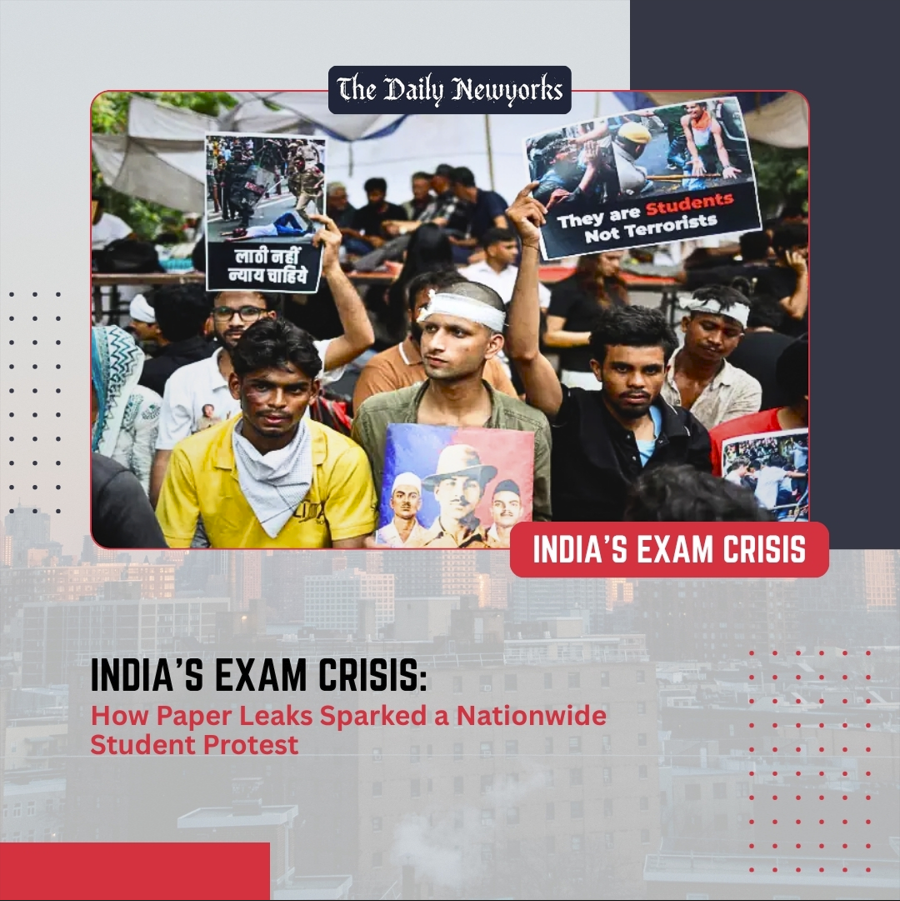
By India’s Exam Crisis: How Paper Leaks Sparked a Nationwide Student Protest
From alleged paper leaks to nationwide student protests, India’s education system is facing one of its biggest tests in years. As millions of students demand accountability and transparency, the crisis has sparked a national debate that carries lessons far beyond India’s borders, including in New York.
For millions of young Indians, education has never been just about earning a degree. It has always represented hope, opportunity, and the promise of a better future. Every year, students dedicate months, and often years to preparing for highly competitive entrance examinations that determine admission to prestigious medical colleges, engineering universities, and government jobs. Families invest their life savings in coaching institutes, study materials, and relocation expenses because they believe one simple idea: hard work should determine success.
But what happens when that belief is shaken?
That’s the question India is confronting today.
The country is witnessing one of its largest student-led protest movements in recent years after allegations of examination paper leaks triggered widespread demonstrations across multiple cities. Thousands of students have taken to the streets under the banner of the Cockroach Janata Party (CJP) and other student organizations, demanding accountability, stronger examination security, and reforms to restore confidence in India’s education system.
According to Associated Press (AP News), the protests have spread across several Indian cities, turning an education issue into a nationwide political debate.
As I followed this story, I realized something important.
This isn’t simply another political controversy or an isolated education issue. It’s about trust.
And once trust in an education system begins to disappear, rebuilding it becomes far more difficult than printing new examination papers.
The crisis also arrives at a time when technology is rapidly transforming education across the globe. Artificial intelligence, online learning platforms, and digital assessments are reshaping classrooms from India to the United States.
We’ve already explored this shift in our article, “AI Tutors Take Over Classrooms: How Artificial Intelligence Is Reshaping Education,” where we discussed how technology is changing the future of learning. Unfortunately, this story reminds us that technology can create new vulnerabilities just as quickly as it creates new opportunities.
A Crisis That Affects Millions
The immediate trigger for the protests was the cancellation of the 2026 National Eligibility cum Entrance Test (NEET-UG) after investigators uncovered evidence suggesting that question papers may have been leaked before the examination.
According to the National Testing Agency (NTA), more than 2.27 million (22.7 lakh) students registered for the examination, making it one of the largest medical entrance exams in the world. Reuters reported that the cancellation forced millions of aspirants to prepare once again while investigations into the alleged paper leak continued.
For many candidates, this wasn’t simply another postponed examination.
It meant another year of uncertainty.
Another year of financial pressure.
Another year of emotional stress.
For students from middle-class and low-income families, where education is often viewed as the primary path toward financial stability and social mobility, the cancellation felt like much more than an administrative decision.
It felt like the system had failed them.
The protests quickly spread beyond Delhi to cities including Mumbai, Bengaluru, Hyderabad, and Kolkata. Students organized peaceful demonstrations demanding transparent investigations, stronger examination security, and accountability from authorities. Their message remained remarkably consistent:
If examinations are meant to reward merit, then the integrity of those examinations must be protected at all costs.
This issue extends well beyond a single entrance examination. India conducts thousands of competitive examinations every year for university admissions, professional certifications, and government recruitment. Millions of students depend on these examinations to shape their futures. Any controversy surrounding their fairness has the potential to weaken public confidence in one of the country’s most important institutions.
The discussion also raises broader questions about the future of education. Around the world, governments are experimenting with digital assessments, AI-assisted learning, and technology-driven classrooms.
New York is witnessing its own transformation in higher education. More students are choosing accelerated learning pathways to reduce costs and enter the workforce sooner, a trend we explored in “Fast-Track Degrees: How New York Learners Are Shortcutting Success.” Whether in New Delhi or New York City, the underlying principle remains the same: students deserve an education system that rewards talent, hard work, and integrity.
More Than a Protest, A Crisis of Confidence
What makes this controversy different is that it goes far beyond one cancelled examination or one alleged paper leak.
For millions of students, the protests represent years of accumulated frustration over recurring reports of examination irregularities. Every time an exam is postponed, cancelled, or questioned, students are forced to put their lives on hold. University admissions are delayed, career plans become uncertain, and families who have invested years of hard work are left wondering whether the system still rewards merit.
For decades, competitive examinations have been viewed as one of India’s greatest equalizers. Whether a student comes from Mumbai, Delhi, Kolkata, or a small village in Bihar or Uttar Pradesh, the examination hall is supposed to provide one thing above all else—an equal opportunity to succeed.
Today, that belief is being tested.
Student organizations across the country have united around a common set of demands:
- Transparent investigations into alleged paper leaks.
- Strict punishment for organized examination fraud.
- Stronger cybersecurity and examination security.
- Greater accountability from examination authorities.
- Faster investigations to reduce uncertainty for students.
- Long-term reforms to restore public trust.
These aren’t simply political slogans.
They are the demands of an entire generation asking one simple question:
“Can we still trust the system?”
The Numbers Behind the Crisis
The scale of India’s education system explains why this controversy has attracted national and international attention.
According to the National Testing Agency (NTA), more than 2.27 million (22.7 lakh) candidates registered for the 2026 NEET-UG examination, making it one of the largest medical entrance examinations in the world. Every year, millions of students compete for a limited number of MBBS seats, creating an intensely competitive environment where even a single mark can determine a student’s future.
The controversy has grown even larger because Rahul Gandhi, Leader of the Opposition, claimed that 152 examination paper leak incidents over the past decade have affected nearly 7.5 crore (75 million) students. While these figures are political claims rather than official government statistics, they have intensified the national debate over examination security and accountability.
Meanwhile, an investigation by The Indian Express found that despite dozens of major paper leak cases reported over the past two decades, only a handful resulted in convictions. The report raises important questions about enforcement, legal accountability, and whether stronger deterrents are needed to prevent organized examination fraud.
Whether one agrees with every political argument or not, one fact remains clear:
When millions of students begin questioning the fairness of competitive examinations, the issue extends far beyond politics.
It becomes a question of institutional credibility.
For me, that’s perhaps the most alarming statistic of all. Not the number of leaked papers.
Not the number of affected students.
But the growing number of young people are beginning to lose faith in a system that was designed to reward merit.
Behind Every Statistic Is a Human Story
Numbers tell us how large a crisis has become.
They rarely tell us how it feels.
Behind every examination roll number is a young person with dreams, ambitions, sacrifices, and years of preparation.
Some students wake before sunrise every morning to study.
Others move hundreds of kilometers away from home to attend coaching institutes.
Many parents work overtime, sell family assets, or take loans simply to give their children an opportunity to compete.
For these families, success isn’t simply about securing admission to a university.
It’s about changing the future of an entire generation.That’s why allegations of examination irregularities create such deep emotional distress.When an examination is cancelled, students don’t simply lose a test date.
They lose confidence.They lose momentum.
They lose months, sometimes years,of emotional investment.
Mental health experts have repeatedly warned that India’s competitive examination system already places enormous psychological pressure on students. Delays, uncertainty, and repeated controversies only make that burden heavier.
We’ve seen similar conversations emerge in New York, where academic pressure, rising education costs, and financial uncertainty continue to affect student well-being.
Technology: Part of the Problem, And Part of the Solution
Ironically, technology sits on both sides of this crisis.
Encrypted messaging platforms, cloud storage, and instant communication make it easier than ever for confidential information to spread rapidly if security systems fail. Organized criminal networks have become increasingly sophisticated, using digital tools to exploit vulnerabilities that didn’t exist a decade ago.
Yet technology also offers some of the strongest solutions available.
Education experts and cybersecurity specialists have recommended several reforms, including:
- AI-powered monitoring systems capable of detecting suspicious activity.
- End-to-end encrypted digital distribution of examination papers.
- Blockchain technology for tamper-proof examination records.
- Biometric identity verification for candidates.
- GPS tracking during transportation of confidential examination material.
- Real-time cybersecurity monitoring and digital surveillance.
As someone who closely follows artificial intelligence, cloud technologies, and digital transformation, I believe this crisis represents something much larger than examination security.
It’s about whether our public institutions are evolving as quickly as technology itself.
India has already demonstrated remarkable innovation through initiatives such as Aadhaar, the Unified Payments Interface (UPI), and one of the world’s fastest-growing startup ecosystems. If similar technological innovation is applied to examination security, it could significantly strengthen transparency and restore public confidence.
However, technology alone isn’t enough.
Without accountability, transparency, and effective governance, even the most advanced digital systems can lose public trust.
That’s a lesson every country, including the United States, should remember.
Ultimately, students don’t simply deserve smarter examinations.
They deserve a system they can believe in.
What Can New York Learn From India’s Experience?
At first glance, India’s examination crisis may appear to be a domestic issue unfolding thousands of miles away. But when you look beyond the headlines, the story carries lessons that resonate with every country that values education as a pathway to opportunity.
New York is home to some of the world’s most respected educational institutions, including Columbia University, New York University (NYU), Cornell University, Fordham University, and the City University of New York (CUNY). Every year, hundreds of thousands of students compete for admission, scholarships, professional licenses, and government positions. Whether it’s the SAT, ACT, LSAT, MCAT, GRE, the New York Bar Examination, or Civil Service Exams, every competitive assessment is built on one essential principle:
Trust.
Students dedicate years to preparing for these examinations because they believe success depends on hard work, discipline, and determination—not on unfair advantages or system failures.
Now imagine if widespread allegations of paper leaks emerged in New York.The consequences would stretch far beyond a single examination.
Universities would face difficult questions about admissions.Professional licensing bodies would come under public scrutiny. Employers could begin questioning the credibility of academic qualifications.
Most importantly, students would lose confidence in a system they had trusted throughout their educational journey.
That is why India’s current crisis deserves global attention.
It reminds us that educational integrity is not simply an Indian concern, it is a shared responsibility for every nation that believes education should reward talent and perseverance.
The Government’s Response: Can Trust Be Restored?
As nationwide protests gained momentum, the Indian government acknowledged growing public concern and promised stronger safeguards to protect the integrity of competitive examinations.
According to Reuters, the Ministry of Education has announced additional reforms while investigations continue into the alleged paper leak network. Authorities have also pledged stricter security measures, enhanced coordination between investigative agencies, and stronger oversight of future examinations.
Meanwhile, student organizations insist that genuine accountability, not simply new promises, will determine whether public confidence can be restored.
After all, trust isn’t rebuilt through press conferences.It’s rebuilt through action. This is precisely why the coming months will be so important.
- Investigations will continue
- Court proceedings will unfold
- Policy reforms will be debated
Millions of students will once again place their futures in the hands of institutions responsible for protecting fairness.
Whether these reforms succeed could shape the future of India’s education system for years to come.
The discussion also raises broader questions about digital governance. Around the world, governments are investing heavily in artificial intelligence, cybersecurity, and digital public infrastructure.
My Perspective: Trust Is the Real Examination
As someone who closely follows technology, artificial intelligence, cybersecurity, and digital transformation, I believe this story goes far beyond politics.
In my opinion, the real examination isn’t taking place inside classrooms.
It’s taking place inside institutions.An examination paper can always be rewritten. A cancelled test can always be rescheduled.
A new date can always be announced.But rebuilding public confidence is far more difficult. Technology has given us extraordinary tools. Artificial intelligence can detect suspicious behaviour.
Blockchain can create tamper-resistant records.
Biometric verification can strengthen identity management. Cloud infrastructure can improve security and scalability.
Yet none of these innovations matter if people stop believing the system is fair. Technology can strengthen trust. It cannot replace it.
That’s why I believe governments, educational institutions, technology leaders, and policymakers all share the same responsibility: protecting the integrity of systems that shape millions of futures.
When students lose faith in merit-based examinations, society loses something much larger than academic credibility. It risks losing confidence in the idea that hard work still matters.
And that’s a dangerous message for any nation to send to its youth.
Final Thoughts
India’s paper leak controversy is no longer just another education story.
It has become a story about trust. A story about accountability. A story about technology.
And above all, a story about millions of young people asking for a system that rewards effort rather than uncertainty. Whether you live in New Delhi, Mumbai, Kolkata, Bengaluru, or New York City, the message remains the same.
Students deserve an education system that is transparent.
They deserve examinations that are secure.
They deserve institutions that protect merit.
And they deserve confidence that years of dedication will never be overshadowed by the failures of the systems designed to evaluate them.
India’s current crisis serves as a reminder that technology alone cannot safeguard education.
Only transparency, accountability, strong governance, and public trust can.
Perhaps that’s the biggest lesson this story offers,not only for India, but for every country that believes education remains the greatest equalizer.
Because in the end, the most important examination isn’t the one students take. It’s the one institution must pass.
Reporting by The Daily Newyorks Staff Writer.