
 By
By AI Embarrasses U.S. Government at Global Conference: The Africa Map Mistake Explained
A mislabeled AI-generated map shown during an international health conference has reignited an important conversation about trust, accuracy, and the role of human oversight in the age of artificial intelligence.
Artificial intelligence has become a powerful tool for creating presentations, writing reports, generating images, and simplifying everyday work. But one recent incident at an international conference has shown that even the smartest technology can make costly mistakes when human oversight is missing.
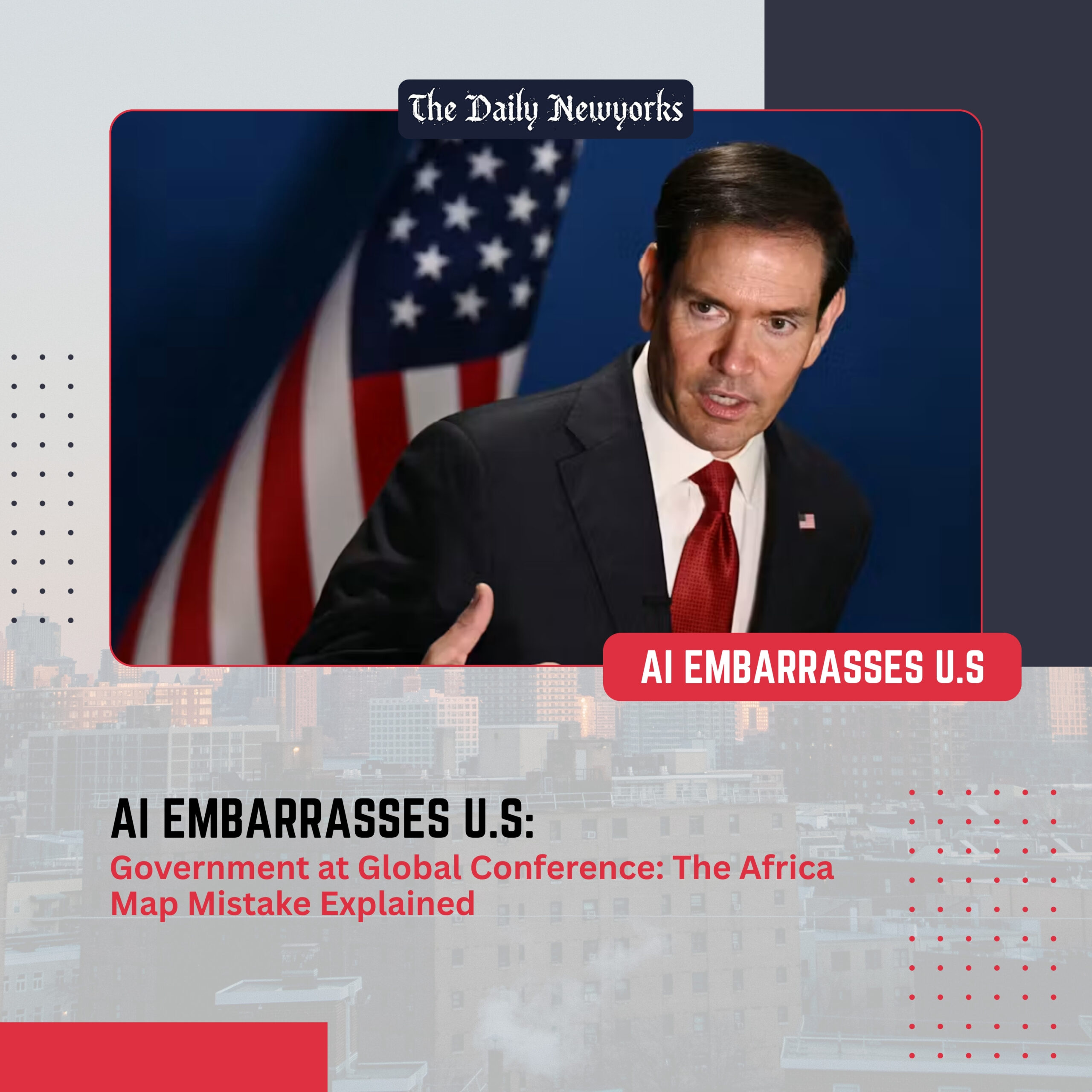
During the AIDS 2026 conference in Rio de Janeiro, Brazil, a presentation delivered by the U.S. State Department displayed a map of Africa in which every country was incorrectly labeled. The mistake quickly caught the attention of attendees, who shared screenshots across social media, turning what should have been a discussion about global health into a worldwide conversation about AI and accountability.
How the Mistake Happened
According to reports, the map appeared midway through a presentation about new U.S. global health agreements. A later analysis found that the image carried an artificial intelligence watermark, indicating it had likely been created using AI-powered image-generation tools.
The State Department acknowledged the mistake soon after it went viral, taking full responsibility for the confusion. Officials explained that a team member had made last-minute changes to the presentation before the event, allowing the inaccurate map to slip through without proper review.
While the explanation clarified how the error occurred, it also highlighted a growing challenge facing governments, businesses, and organizations worldwide: how to safely integrate AI into professional workflows without compromising accuracy.
Why the Map Drew Global Attention
The errors were impossible to ignore.
Nigeria, Africa’s most populous country, appeared far from its real location. Mozambique was moved hundreds of miles away, while Côte d’Ivoire was incorrectly placed on the opposite side of the continent. Nearly every country label was wrong.
For an international audience that included African health officials, researchers, and policymakers, the mistakes appeared more than just embarrassing. Geography is not merely about locations on a map. It represents national identity, history, and diplomacy.
Displaying an inaccurate map during a global conference naturally raised questions about preparation and attention to detail.
AI Is a Tool, Not an Expert
The incident has also reminded the world of an important truth about artificial intelligence.
AI systems are designed to generate content based on patterns they have learned from massive amounts of data. They can create realistic images, write convincing articles, and produce professional-looking graphics within seconds.
However, AI does not understand geography, history, or politics in the same way humans do. It predicts likely outputs rather than verifying factual accuracy.
This means AI-generated visuals should never be treated as final versions without careful human review.
The Africa map serves as a clear example that impressive design does not always equal correct information.
Human Oversight Matters More Than Ever
Although artificial intelligence played a role in creating the map, experts have pointed out that the real issue was not AI alone.
Several opportunities existed for people to identify the errors before the presentation reached an international audience.
Every official presentation typically passes through multiple stages of review. Designers create the slides, managers approve them, communications teams review messaging, and presenters usually rehearse beforehand.
Somewhere along that process, the inaccurate map was overlooked.
That makes this incident less of a technology failure and more of a workflow failure.
As organizations increasingly adopt AI, human verification becomes even more important rather than less.
What Organizations Can Learn
The rapid adoption of generative AI is transforming workplaces across industries. From government agencies to private companies, AI is helping professionals work faster than ever before.
But speed should never replace accuracy.
Experts recommend that organizations establish clear policies for reviewing AI-generated content, especially when producing official reports, presentations, educational materials, or public communications.
Simple verification steps, such as checking maps, statistics, names, and factual information can prevent mistakes that may damage public trust.
AI works best when it supports human expertise instead of replacing it.
A Lesson Beyond One Conference
The State Department’s swift apology demonstrated accountability, but the incident will likely remain an important case study in responsible AI use.
As artificial intelligence becomes part of everyday work, professionals must remember that technology is only as reliable as the people using it.
Whether creating business presentations, government reports, marketing campaigns, or educational resources, human judgment remains essential.
The Africa map mistake is not just a story about an incorrect image. It is a reminder that trust is built through careful review, attention to detail, and responsible use of emerging technology.
In an era where AI can generate polished content within seconds, accuracy is no longer guaranteed by appearance alone. The organizations that earn lasting public confidence will be those that combine innovation with thoughtful human oversight—ensuring that technology enhances decision-making rather than replacing it.
As AI continues to reshape the future of work, this incident serves as a timely reminder that the most important quality in any official communication is not how quickly it is created, but how carefully it is verified.
Reporting by The Daily Newyorks Staff Writer.