

 By
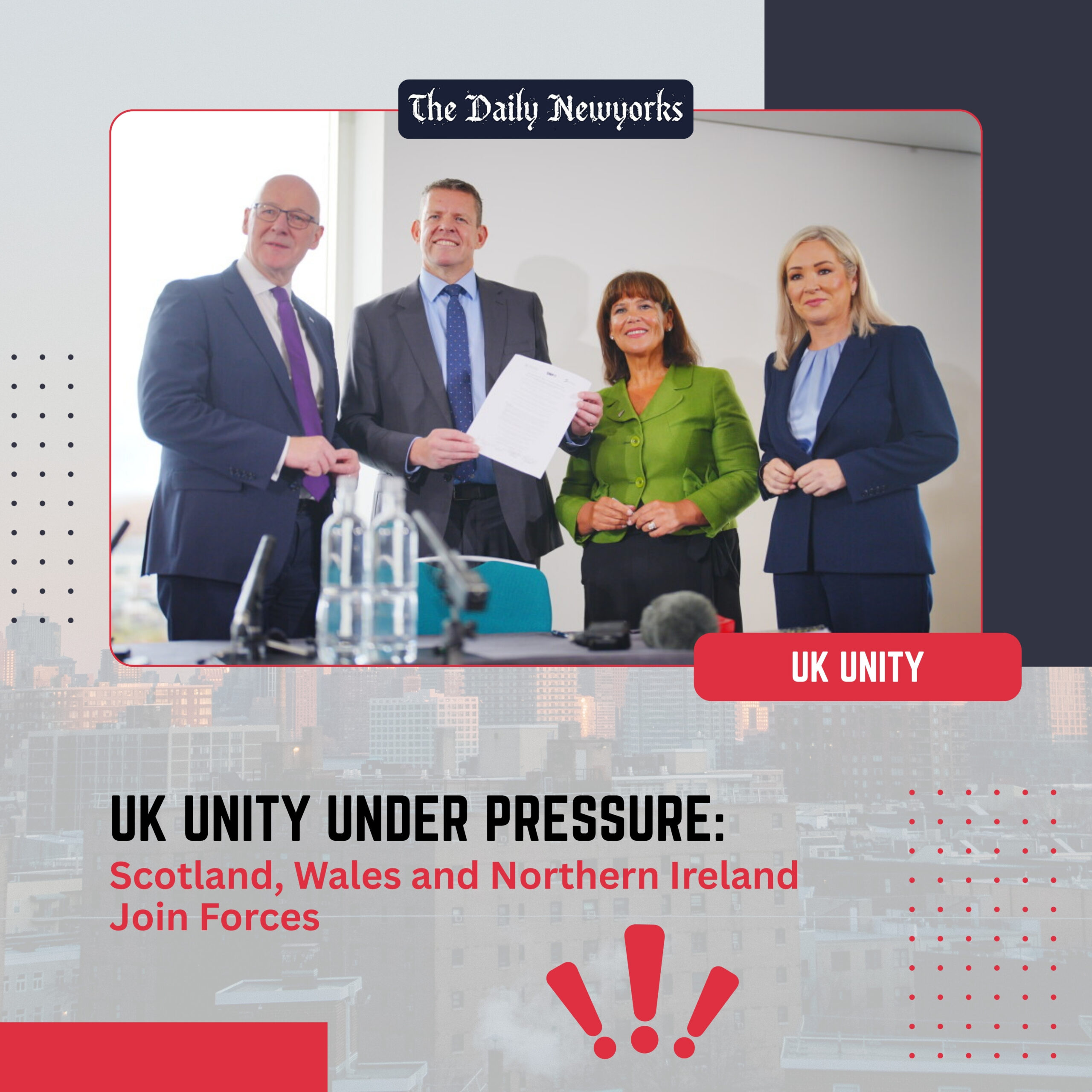
By UK Unity Under Pressure: Scotland, Wales and Northern Ireland Join Forces
Scotland, Wales and Northern Ireland have signed a new political pact calling for constitutional change, putting fresh attention on the future of the United Kingdom.
The United Kingdom is facing a new constitutional debate.
On September 14, 2026, the leaders of Scotland, Wales and Northern Ireland signed a memorandum of understanding in Cardiff calling for the UK government to prepare for possible constitutional change. The agreement brings together three nations with different political histories but a shared demand for greater control over their futures.
The development does not mean the United Kingdom is breaking apart. The memorandum itself does not change the law or automatically create a path to independence. But it puts the question of the UK’s constitutional future back at the center of British politics.
For readers following international politics from New York, the story is another reminder that political questions about identity, regional power and national sovereignty are reshaping democracies far beyond the United States.
What Happened in Cardiff?
The agreement was signed by Scotland’s First Minister John Swinney, Wales’ First Minister Rhun ap Iorwerth and Northern Ireland’s First Minister Michelle O’Neill, alongside leaders of the Scottish National Party, Plaid Cymru and Sinn Féin.
The three political movements have different goals.
Scotland’s nationalist movement seeks independence. Wales’ Plaid Cymru advocates greater Welsh self-government and independence. In Northern Ireland, Sinn Féin supports Irish reunification.
Their joint memorandum says Westminster should prepare for, plan and facilitate constitutional change in the three nations.
The symbolism is significant. The legal effect is not.
University of Glasgow researcher Nicola McEwen told AP that the summit was symbolically important but had no legal significance.
That distinction is crucial to understanding what comes next.
A United Kingdom of 69 Million People
The constitutional debate involves a country of enormous scale.
The Office for National Statistics estimated the UK’s population at 69.28 million in mid-2024. England accounted for about 58.62 million people, while Scotland had about 5.55 million, Wales about 3.19 million and Northern Ireland about 1.93 million.
Together, Scotland, Wales and Northern Ireland represented roughly 10.7 million people, or about 15% of the UK’s population, based on those ONS estimates.
That means the constitutional question involves millions of people and major institutions, economies and public services.
It is not simply a disagreement between political leaders in Edinburgh, Cardiff, Belfast and London.
Devolution Changed Britain
To understand today’s tensions, it helps to look back to the late 1990s.
The UK introduced a devolved government in Scotland, Wales and Northern Ireland after referendums in the 1990s.
Scotland’s Parliament was re-established in 1999. The Scottish Government says devolved powers transferred to Scottish ministers included areas such as education, justice, health and aspects of the economy.
The system created a new political reality.
London remained responsible for reserved matters such as defense, foreign affairs and other UK-wide responsibilities, while elected institutions in Edinburgh, Cardiff and Belfast gained authority over significant domestic issues.
But devolution did not make the three nations independent states.
Westminster retained ultimate constitutional authority. That distinction has become one of the central issues in the current debate.
Scotland’s Independence Question Has History
Scotland has already held an independence referendum.
On September 18, 2014, voters were asked whether Scotland should become an independent country.
The result was:
- 55.3% voted No
- 44.7% voted Yes
- Turnout reached 84.6% when rejected ballots were included.
The referendum settled the question politically at the time, but it did not end the independence debate.
Brexit subsequently changed the political environment.
The UK voted to leave the European Union in 2016, while Scotland voted by a substantial majority to remain. The UK’s departure from the EU later became an important part of arguments surrounding Scotland’s constitutional future.
In 2026, Scotland’s First Minister John Swinney is again calling for an independence referendum, while the UK government has maintained that another vote is not currently on the table.
Wales Is Taking a Different Route
Wales is part of the same constitutional conversation, but its position is different.
The Welsh government operates through the Senedd, Wales’ devolved legislature, while Westminster retains powers over reserved areas.
The current Welsh leadership has joined the broader call for constitutional change, but unlike Scotland, Wales has not announced a timetable for an independence referendum.
That makes the Cardiff pact more of a political statement of cooperation than a coordinated timetable for three independence votes.
The three nations are aligned on the principle of greater self-determination, but their constitutional routes are not identical.
Northern Ireland Has Its Own Constitutional Path
Northern Ireland’s situation is particularly different because its constitutional future is connected to the 1998 Good Friday Agreement.
The agreement provides a mechanism for a border poll on Irish unity if the relevant legal conditions are met.
AP reports that the UK government says the threshold for such a vote has not been reached. Ireland would also have to approve any constitutional change through a referendum.
This means Northern Ireland’s route toward a possible change in constitutional status is not the same as Scotland’s or Wales’.
The Cardiff agreement brings the three political movements together, but their legal mechanisms remain separate.
Why the Pact Matters
The biggest immediate effect may be political rather than legal.
For years, debates over Scotland, Wales and Northern Ireland have largely developed along separate tracks.
The new pact creates a common platform.
That could allow the three governments and political movements to cooperate on issues such as constitutional reform, economic policy, energy and relations with Europe. Reporting ahead of the agreement described cooperation on those areas as part of the wider agenda.
It also gives Westminster a more coordinated political challenge. But cooperation does not necessarily mean that all three nations will follow the same path.
Scotland has a history of holding an independence referendum. Northern Ireland has a separate reunification mechanism.
Wales has no comparable independence referendum process currently scheduled.
The differences matter.
The Westminster Question
The UK government’s response has focused on preserving the union and addressing domestic economic priorities rather than reopening immediate constitutional questions.
That creates a familiar tension in British politics:
Who should have the final say over a nation’s constitutional future, Westminster or the nation itself?
Supporters of independence argue that voters in Scotland, Wales and Northern Ireland should have greater control over their constitutional choices.
Unionist politicians argue that the United Kingdom remains a shared political state and that constitutional change requires broader agreement.
Those are competing political positions, and the new pact has intensified the debate rather than resolved it.
What the Numbers Tell Us
The available statistics provide important perspective.
The 2014 Scottish referendum had exceptionally high participation, with turnout above 84%.
Meanwhile, the UK’s population reached approximately 69.3 million in 2024, according to the ONS.
Scotland, Wales and Northern Ireland together account for roughly 10.7 million residents.
Those numbers show both the scale of the United Kingdom and the size of the populations involved in the constitutional debate.
But population numbers alone cannot determine the political future.
That depends on elections, public opinion, legislation, negotiations and, where legally applicable, referendums.
Why New Yorkers Should Pay Attention
New York has its own long history of debates over local government, state authority and the relationship between cities and larger political institutions.
The UK debate is different, but the underlying question is familiar:
How much power should be held centrally, and how much should be controlled closer to the people affected by those decisions?
That question appears in democracies around the world.
For readers of The Daily Newyorks, the British constitutional debate offers a wider look at how regional identities can influence national politics.
It also demonstrates why constitutional change rarely happens overnight. Political agreements can change the conversation long before they change the law.
What Happens Next?
The September 14 pact is an important political development, but it is only one step in a much longer process.
Scotland would need a legally recognized route to another independence referendum.
Northern Ireland’s constitutional future is governed by the consent framework established under the Good Friday Agreement.
Wales faces its own political and constitutional debate without an immediate referendum timetable.
And Westminster remains central to the UK’s constitutional framework.
For now, the most accurate way to describe the Cardiff agreement is not as the breakup of Britain, but as a new and coordinated challenge over how Britain should be governed.
The United Kingdom remains intact.
The argument over what that union should look like is becoming harder to ignore.
The Bigger Picture
Britain’s constitutional story has entered another chapter.
The 2014 Scottish referendum demonstrated that independence could become a mainstream democratic question. Brexit changed the UK’s relationship with Europe. Devolution gave Scotland, Wales and Northern Ireland greater political institutions of their own. Now, the leaders of all three have joined in a common call for constitutional change.
Whether that produces further devolution, new referendums, greater cooperation or something more fundamental remains a matter for voters, governments and future negotiations.
For now, one fact stands out:
The debate over the future of the United Kingdom is no longer being conducted only in Westminster.
Reporting by The Daily Newyorks Staff Writer.