
 By
By Edge of Midnight: Trump’s Iran Ultimatum and the World on a Knife’s Edge
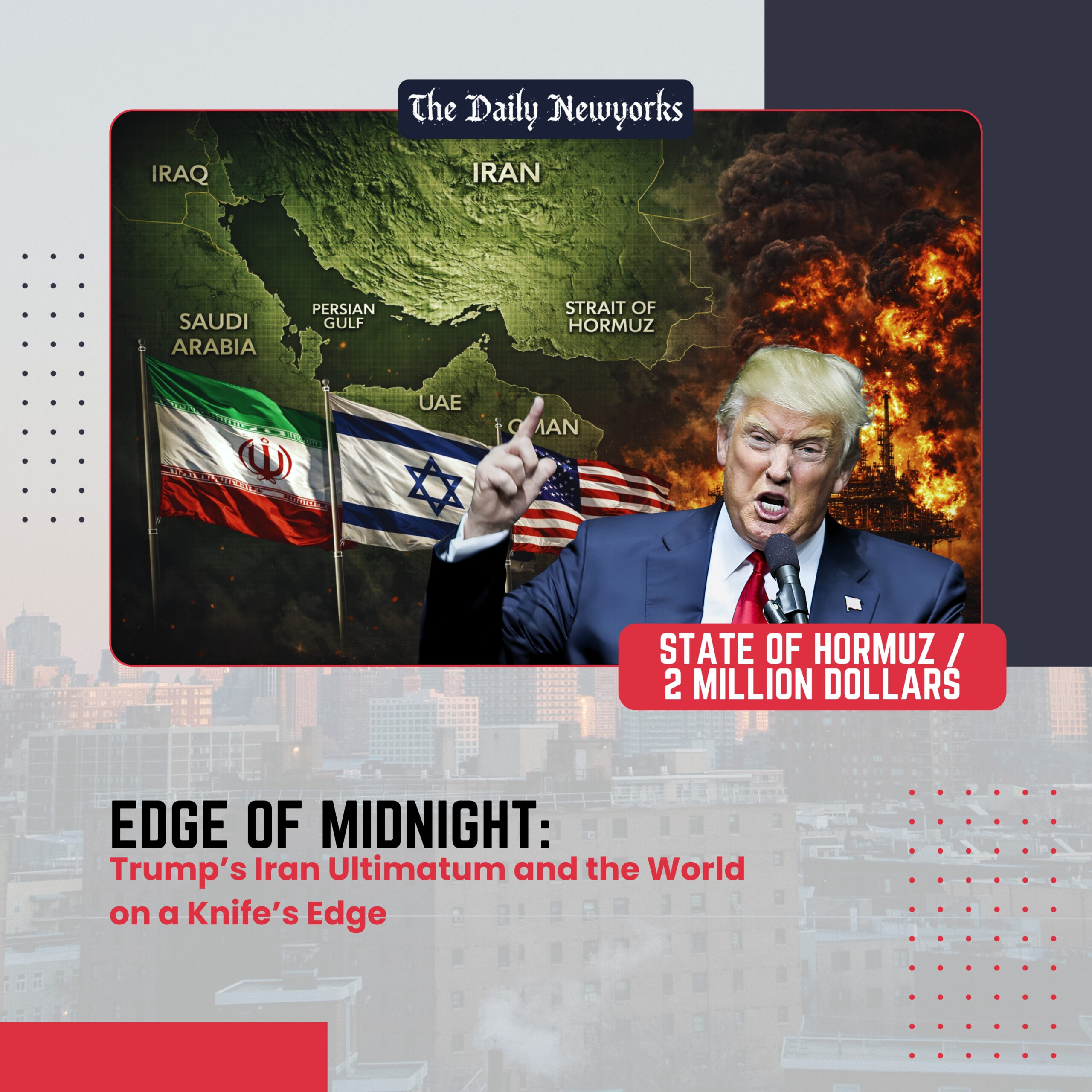
Trump warns ‘a whole civilization will die tonight’ if Iran fails to meet his deadline
The Sentence That Froze the Clock
There are political statements, and then there are moments that feel like history holding its breath.
When Donald Trump declared that “a whole civilization will die tonight,” the words didn’t just travel across headlines. They pierced through diplomatic language, replacing nuance with something far more dangerous: certainty.
This was not a policy briefing. It was a countdown.
And at the center of it lies a narrow stretch of water, the Strait of Hormuz, where global economics, military strategy, and national pride collide.
But this crisis is no longer about geography. It is about how far nations are willing to go to prove they won’t back down.
America’s Logic: Fear as a Strategic Tool
From Washington’s vantage point, the equation is brutally simple: instability in the Gulf equals instability everywhere.
The United States sees itself not just as a participant, but as a guarantor of global order. And in that role, allowing a chokepoint like Hormuz to fall under threat is not an option—it is a vulnerability.
Military actions, including strikes near Kharg Island, are framed not as aggression but as enforcement. Enforcement of what, exactly? A system where trade flows freely and threats are neutralized before they mature.
Supporters of this doctrine argue:
- Power, when clearly demonstrated, prevents miscalculation
- Ambiguity invites risk; certainty enforces restraint
- Economic security is inseparable from military readiness
In this reading, Trump’s words are not reckless, they are intentional. A shock tactic designed to force a decision, to compress diplomacy into hours instead of months.
It is the language of pressure, not patience.
Iran’s Reality: Survival in the Shadow of Power
For Iran, however, the narrative unfolds differently, less about global systems and more about national survival.
Decades of sanctions, isolation, and external pressure have shaped a political identity built on resistance. To yield under threat would not just be a strategic loss. It would be a symbolic collapse.
When Masoud Pezeshkian speaks of sacrifice, it is not merely rhetoric. It taps into a historical memory where endurance is seen as victory.
Iran’s position is layered:
- Sovereignty cannot be negotiated under threat
- Military pressure validates long-held fears of foreign dominance
- Concessions without guarantees invite future aggression
Even its reported diplomatic proposals, linking de-escalation to sanctions relief and security assurances reflect a deeper demand: respect as an equal actor, not a controlled variable.
In this context, defiance is not escalation. It is identity.
The Expanding Circle of Risk
What makes this moment uniquely dangerous is not just the tension between two nations. But the speed at which it is pulling others in.
Missiles do not recognize borders, and neither do consequences.
As strikes and counterstrikes ripple outward, countries across the Gulf—Saudi Arabia, Bahrain, the United Arab Emirates, find themselves not as observers, but as participants in a widening theater.
The economic aftershocks are already visible:
- Energy markets swinging with every headline
- Supply chains recalibrating in real time
- Governments preparing for prolonged instability
Meanwhile, the diplomatic arena is fracturing. A United Nations effort to secure maritime safety collapsed under vetoes from Russia and China, exposing a deeper truth: even global governance is divided on how to respond.
This is no longer a crisis. It is a convergence of crises.
When Strategy Meets Morality
There is a line in modern conflict, often referenced, rarely respected—between military necessity and humanitarian consequence.
Targeting infrastructure like bridges, power grids, and water systems may offer tactical advantage. But it also raises a question that strategy alone cannot answer:
At what point does deterrence become destruction?
International law is clear in principle but fragile in practice. The distinction between military and civilian targets is not just legal—it is moral.
And yet, in high-stakes standoffs, morality often becomes negotiable.
This is where the debate sharpens.
- Can extreme threats prevent extreme outcomes?
- Or do they normalize them?
The Power and Danger of Words
In previous eras, such statements might have taken hours, even days, to circulate. Today, they reshape reality in seconds.
Trump’s warning did not just describe a possibility. It created one.
Markets reacted. Militaries recalibrated. Citizens, thousands of miles away, began to imagine the unthinkable.
Language at this level is no longer communication. It is action.
And action, once taken, is difficult to reverse.
A Balanced Reckoning
To view this moment honestly is to resist simplicity.
The United States is not wrong to prioritize global stability. The free flow of energy and trade underpins modern life, and disruptions carry real consequences.
Iran is not wrong to resist external pressure. History has shown that nations forced into submission rarely forget, and rarely forgive.
Both positions are rational. Both are dangerous.
Because when rational actors refuse to yield, conflict does not resolve. It escalates.
The Thin Space Between Control and Chaos
What makes this moment so precarious is not just what has happened. But what could happen next.
All the elements are in place:
- Military readiness
- Political rigidity
- Global stakes
- Compressed timelines
What is missing is trust.
And without trust, even the smallest misstep, a misread signal, an unintended strike, or a delayed response can trigger consequences far beyond intention.
History is filled with wars that no one officially declared, but everyone ultimately fought.
The Takeaway: A World Deciding in Real Time
This is not a distant conflict playing out in isolation. It is a live test of how power is exercised in the modern world.
Will strength enforce peace, or provoke resistance?
Will defiance preserve sovereignty, or deepen isolation?
There are no easy answers, only outcomes that will define the next decade.
Trump’s ultimatum may have been designed to force clarity. Instead, it has revealed complexity.
And in that complexity lies the real danger.
Because in a world where every move is amplified, every word carries weight, and every second counts, the line between strategy and catastrophe is thinner than ever.
Reporting by The Daily Newyorks Staff Writer.