

 By
By Poetry on the Subway: The Words That Move New York Mornings
How short verses on long commutes make the city breathe again.
A Quiet Revolution Beneath the Tracks
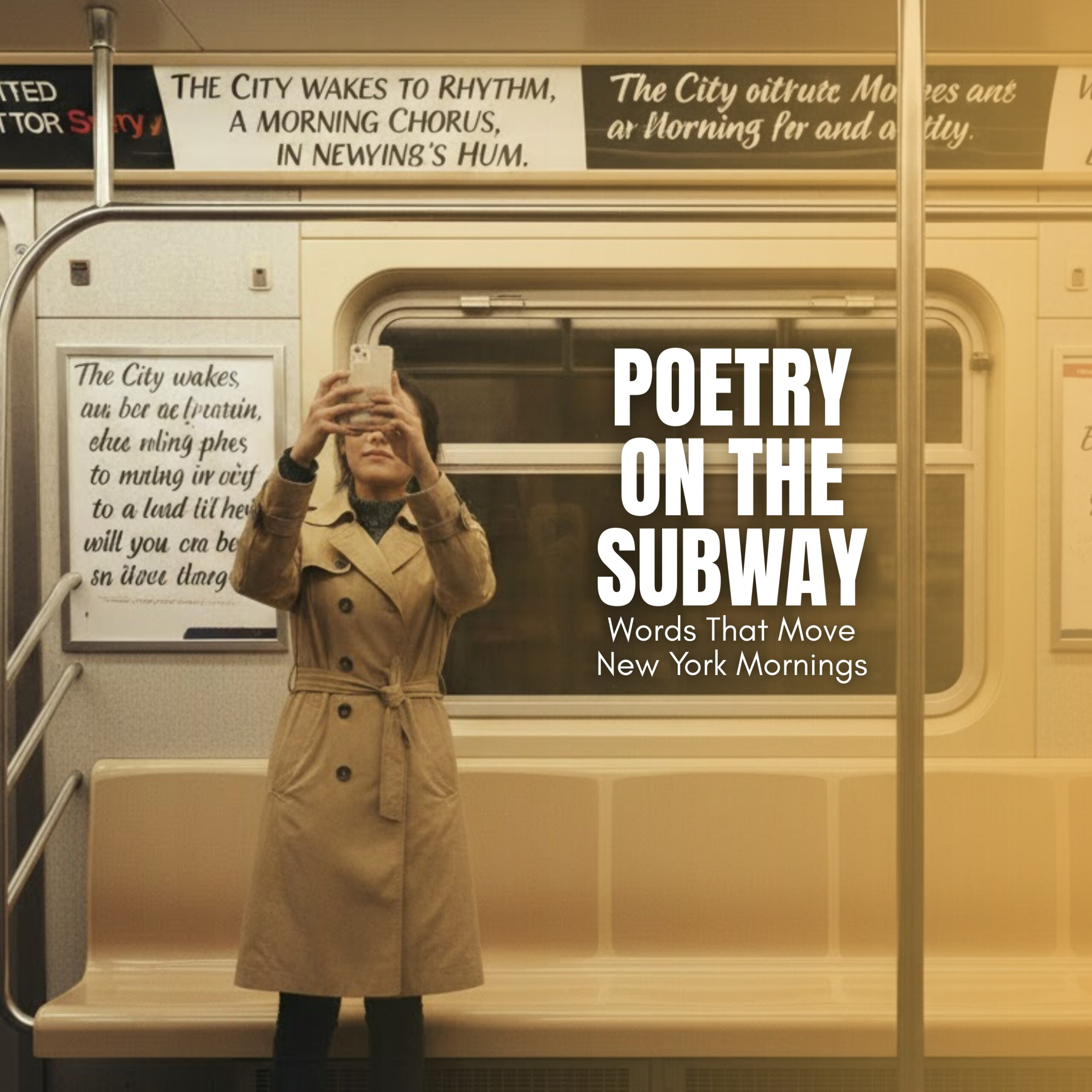
It’s early morning in New York. The subway hums with tired faces, coffee cups, and the sound of wheels on steel. Amid the noise, a line of poetry catches the eye:
“Hope is the thing with feathers that perches in the soul.”
For a moment, the rush slows down. A small verse brings calm.
That’s the quiet magic of Poetry in Motion, a program run by the MTA and the Poetry Society of America since 1992. What started as a small idea, to bring art into everyday life has become one of New York’s most loved public traditions.
Words Between Stops
More than 1.7 billion subway rides are taken in New York City each year (MTA Annual Report 2023). That’s billions of chances for riders to look up from their screens and see something that speaks to them, not an ad, but a poem.
Since its launch, Poetry in Motion has featured over 250 poems from famous writers like Langston Hughes and Emily Dickinson to new voices from local schools. Each poem fits neatly on a small panel, often beside a seat or above a door, just enough to read before the next stop.
“It’s a pause button in the middle of chaos,” says subway rider Tanya Lopez, who commutes from Queens to Midtown. “You see a line that hits you, and suddenly your day feels lighter.”
How It Started
Back in the early 1990s, New York’s subway walls were crowded with posters and ads. The idea of filling some of that space with poetry came from Sandra Bloodworth, the director of MTA Arts & Design.
She wanted the subway to reflect not just the city’s speed, but also its spirit.
“New York is full of voices,” she once said in an interview. “Poetry is how we hear them.”
The first poem appeared on trains in 1992. It was a few short lines from Walt Whitman’s Crossing Brooklyn Ferry. People noticed. Soon, letters started coming in. Riders wanted more.
Today, the project continues to thrive, with new poems rotating every few months across the MTA network.
A City That Speaks in Verse
For many New Yorkers, poetry on the subway is more than art. It’s comfortable.
A 2022 survey by the National Endowment for the Arts found that 45% of urban Americans say reading or seeing poetry in public spaces makes them feel more connected to their community (NEA Report). In New York, that sense of connection travels underground every day.
“When I see a poem on the train, I feel less alone,” says Jordan Miles, a Brooklyn-based teacher. “It reminds me that words still matter, even in a city that never stops moving.”
The Science of Small Words
Experts say reading poetry, even a short line, can reduce stress and lift mood. A 2023 study by the University College London found that poetry triggers brain activity similar to listening to music, especially in areas linked to emotion and memory.
So, while commuters may not realize it, those few seconds with a poem might actually make them happier and more focused.
“Poetry slows us down just enough to think,” says Dr. Lila Morton, a cultural psychologist. “That small act can change how people feel about their day, or even about each other.”
Modern Voices, Modern Subways
As the city modernizes its subway system, poetry has also evolved. Recent panels include lines from young poets writing about climate change, social justice, and digital life.
In 2024, the MTA introduced digital poetry displays on select lines, allowing poems to appear in rotation across screens in real-time. It’s a mix of old soul and new tech, very New York.
“Poetry belongs everywhere,” says Marcus Reynolds, an MTA Arts & Design curator. “If people spend hours underground, those walls should give them something more than silence.”
Impact on the City’s Rhythm
Public art programs like Poetry in Motion aren’t just nice to look at, they shape how people experience the city.
According to Americans for the Arts, every dollar invested in public art returns about $5 in community benefits, from increased civic pride to local tourism (Source). The poetry panels cost far less than ads but create value of money can’t easily measure calmness in a crowded train, or unity in a divided time.
For many, it’s proof that art doesn’t have to be framed in a museum. It can live between stops, next to maps and metal poles, whispering quietly: you belong here too.
Commuter Voices
“I take the F train every morning. There’s this poem by Audre Lorde that I see near 14th Street. It’s just one line, but I swear it makes me breathe better.”
— Leah Kim, student, Brooklyn College
“The poems are tiny reminders that beauty exists in small spaces. Even underground.”
— Carlos Mendes, train operator, MTA
“It’s like free therapy on your way to work.”
— Rita Patel, nurse, Bronx
Why It Matters Now
In a time when screens rule attention and stress runs high, the subway’s poetry feels more needed than ever.
New York’s average commute time is about 42 minutes, the longest in the U.S., according to the Census Bureau (Source). That’s 42 minutes where frustration can grow, or where calm can sneak in through a few thoughtful words.
Poetry doesn’t fix traffic delays or broken signals. But it does something quieter. It helps people endure them.
The Future of Words on Wheels
The MTA plans to expand its art programs across buses and commuter rails. There’s also talk of featuring AI-curated poetry, where algorithms select verses based on seasons, weather, or local events, blending technology with timeless words.
It’s a sign that even as New York races toward the future, it hasn’t forgotten the power of something simple: a few good lines on a bad day.
The Heart of the City
Every subway car tells a story of faces, sounds, and journeys that cross every kind of life. The poems are like gentle pauses between those stories.
They remind New Yorkers that the city’s heartbeat isn’t just in skyscrapers or streetlights. It’s in the quiet rhythm of words shared between strangers underground.
So tomorrow morning, when the train doors close and the crowd sways together, look up. Somewhere above the noise, a poem is waiting. And it might just move you more than the train itself.
Reporting by The Daily Newyorks Staff Writer.