
 By
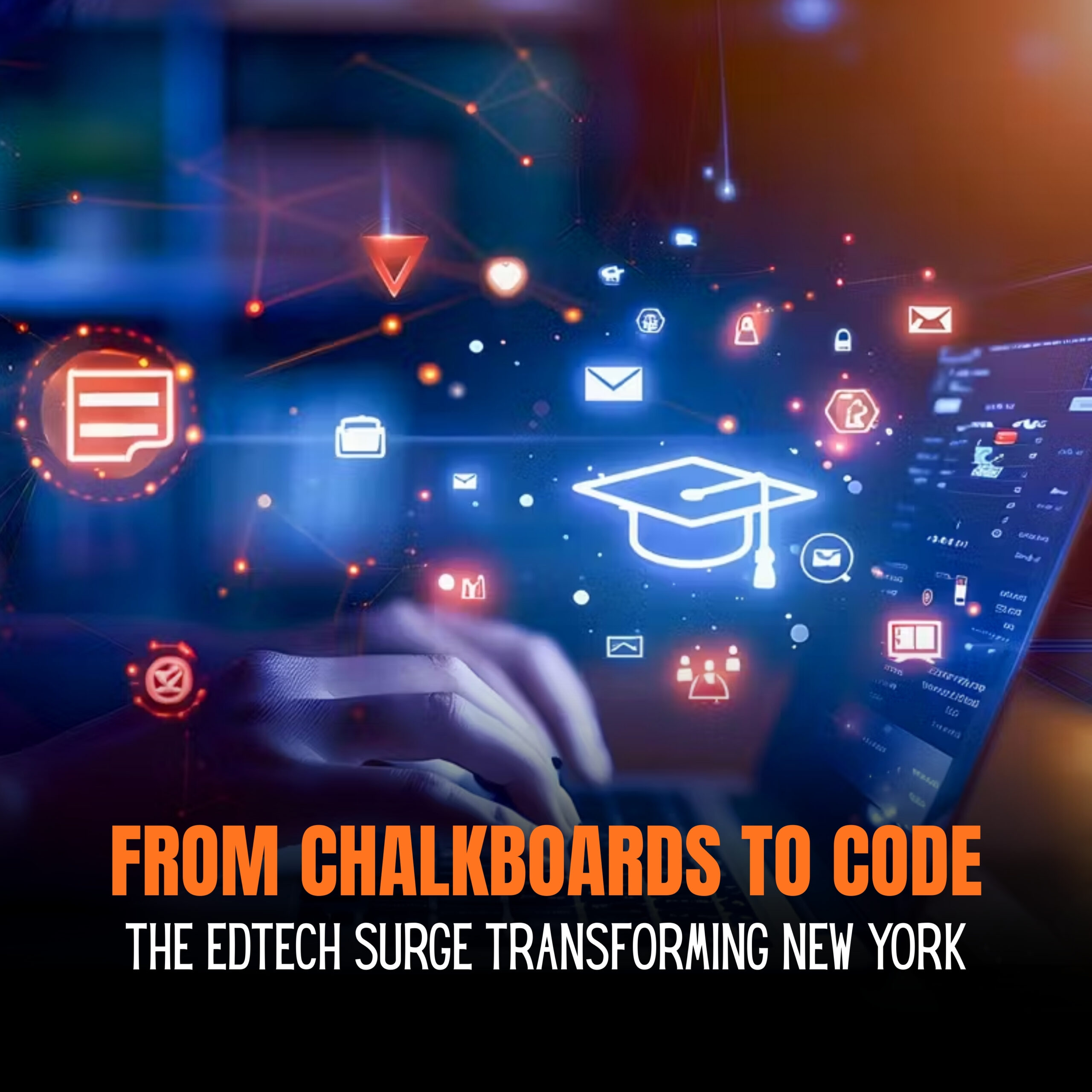
By From Chalkboards to Code: The EdTech Surge Transforming New York
Technology is reshaping New York’s classrooms, but can innovation keep pace with equity and access?
From smart boards to AI-powered learning platforms, the EdTech boom in New York City is redefining how teachers teach and how students learn. What began as an emergency shift during the pandemic has now evolved into a long-term transformation of the city’s education system.
But as digital learning accelerates across NYC classrooms, a critical question remains: Can education technology grow without deepening inequality?
A Digital Shift Across New York Classrooms
Walk into a fifth-grade classroom in Brooklyn today and you’re more likely to see tablets and coding software than chalk and notebooks. Traditional blackboards still hang on walls, but increasingly as relics rather than tools.
Across New York City, schools are embracing digital learning tools at record speed. The shift toward education technology (EdTech) has transformed lesson plans, homework systems, classroom collaboration, and even parent communication.
According to the New York City Department of Education, more than 800,000 students now use digital learning platforms daily. What started as remote instruction during COVID-19 has evolved into a permanent hybrid learning ecosystem.
The keyword defining this era? EdTech in NYC classrooms.
The Rise of EdTech Startups in New York
New York is not just adopting EdTech, it’s building it.
In 2024 alone, more than $250 million in venture capital flowed into New York-based education technology startups, according to Crunchbase.
Leading platforms expanding in the city include:
- ClassDojo
- Brainly
- GoGuardian
These companies offer AI-powered tutoring, student engagement tracking, real-time progress dashboards, and classroom monitoring systems.
Dr. Aaron Wells, an education policy analyst at Columbia University, explains:
“The pandemic didn’t just push education online. It permanently integrated technology into learning expectations. Students now assume digital tools are part of every lesson.”
The EdTech surge is no longer temporary. It is structural.
The Benefits of Education Technology in NYC Schools
The expansion of digital learning in New York schools has brought measurable advantages.
Personalized Learning
AI-powered platforms now analyze student performance in real time. Adaptive software adjusts difficulty levels automatically, offering targeted support in math, reading, and science.
A 2023 study by McKinsey & Company found that adaptive learning technology improved student progress rates by up to 30% in certain subjects.
Virtual Labs and Global Classrooms
Science students can now conduct virtual experiments without expensive lab equipment. Language learners connect with peers across continents through live digital exchanges.
Greater Accessibility
Remote learning tools allow homebound students and underserved communities to access lessons previously limited by geography or funding.
For a city as diverse as New York, inclusive digital education is not just innovation. It’s a necessity.
The Digital Divide in New York
Yet the EdTech boom in NYC reveals a persistent challenge: unequal access.
In parts of the Bronx and Queens, reliable broadband and personal devices remain inconsistent. The New York State Comptroller’s Office reports that 13% of city households with school-age children still lack broadband internet at home.
That gap translates directly into missed lessons, reduced engagement, and falling behind academically.
The digital divide in New York schools threatens to create a two-tier education system:
- Students with seamless tech access
- Students struggling to log in
EdTech can bridge inequality, or widen it.
Teacher Training and Tech Fatigue
While devices have arrived in classrooms, professional development hasn’t always kept pace.
Many educators report limited training in using AI-driven education platforms effectively. Without structured guidance, even advanced tools risk becoming underutilized.
Additionally, years of remote learning have created screen fatigue. Parents increasingly worry about excessive device use. Research from Pew Research Center shows that 68% of parents believe children spend too much time on digital devices.
The future of EdTech in New York must balance innovation with human connection.
NYC as a National EdTech Innovation Hub
New York is emerging as one of America’s leading EdTech ecosystems.
Startup accelerators such as:
- NewLab
- Techstars NYC
are mentoring companies focused on AI-driven education tools.
Universities are stepping in as well:
- NYU Tandon School of Engineering launched an AI in Education Lab dedicated to responsible generative AI use.
- Columbia University expanded scholarships for teachers pursuing AI ethics and data literacy training.
New York doesn’t just want to adapt to the future of education technology. It wants to lead it.
Education and the Digital Economy
The transformation of NYC classrooms directly impacts the city’s workforce.
According to the NYC Economic Development Corporation, the city’s tech sector already employs more than 369,000 people, with projected growth of 15% by 2030.
Today’s middle-school coder could become tomorrow’s software engineer.
If EdTech adoption in NYC succeeds equitably, it strengthens the city’s long-term economic competitiveness. If not, inequality may deepen across boroughs.
The Road Ahead for EdTech in NYC
Experts agree that the next phase must focus on smart implementation, not just expansion.
Priorities for Sustainable Digital Learning:
- Guarantee device and broadband access in every borough
- Invest in teacher training and AI literacy
- Maintain hybrid models blending in-person and digital instruction
- Monitor performance data to ensure real academic gains
The city’s Digital Learning Initiative has already committed millions toward these goals. But scaling equitable access remains the defining challenge.
My Opinion
New York classrooms are evolving rapidly. Screens glow where chalk once ruled. Coding lessons replace rote memorization. AI tutors assist teachers.
But technology alone cannot solve educational inequality.
If New York truly wants its EdTech revolution to succeed, it must ensure every student, from the Bronx to Staten Island, stands on equal digital ground.
Because in the end, innovation isn’t measured by devices distributed.
It’s measured by opportunities created.
Reporting by The Daily Newyorks Staff Writer.