
 By
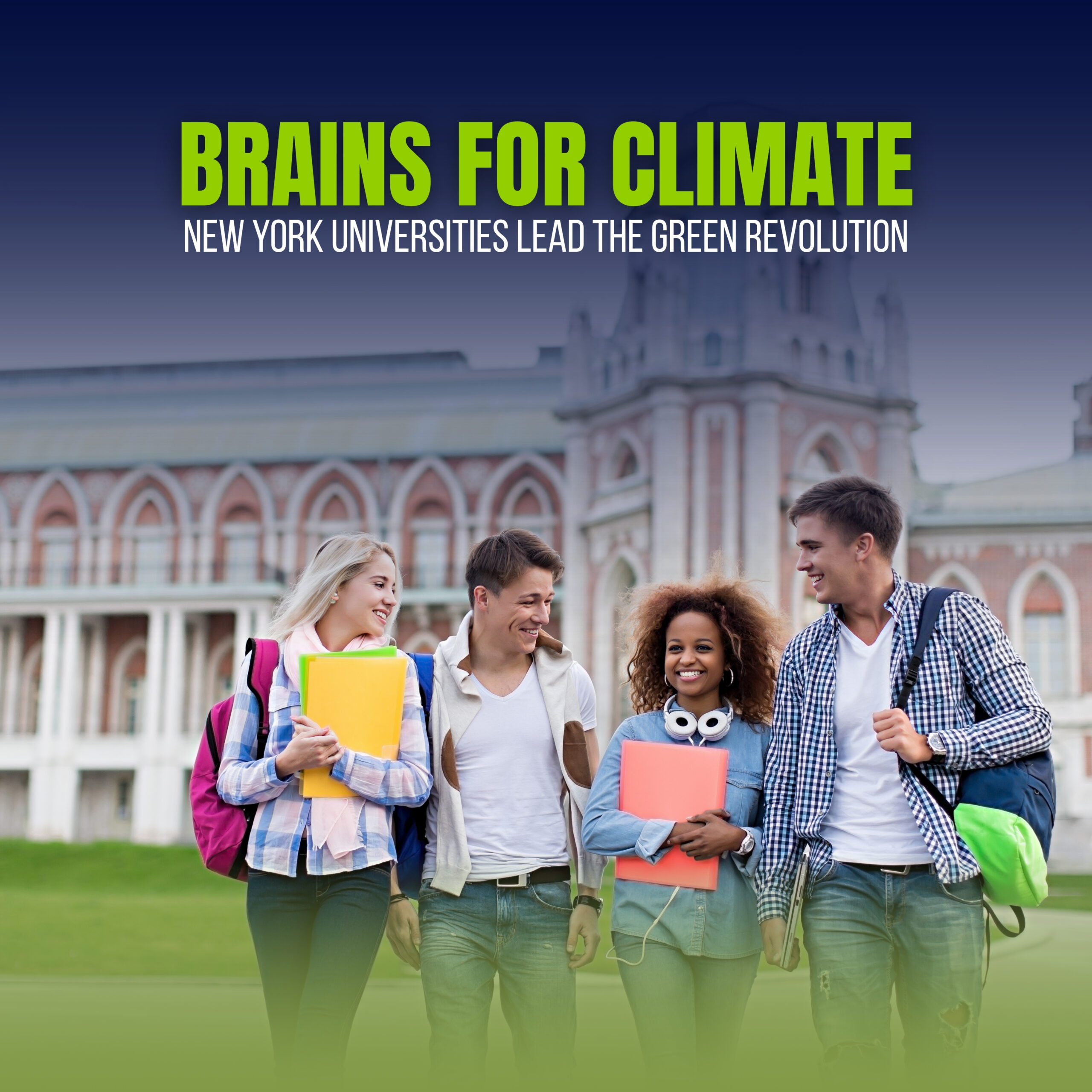
By Brains for Climate: New York Universities Lead the Green Revolution
From rooftop labs to riverfront projects, New York’s universities are turning the city into a living classroom for the planet’s future.
A City Turning Ideas Into Action
At Columbia University’s Morningside Heights campus, students are not just studying climate change, they’re building tools to fight it. Across town, at New York University, engineers are testing ways to capture carbon right from city air. Meanwhile, The City University of New York (CUNY) is transforming its rooftops into solar learning hubs.
This is New York’s new revolution: a green one.
With record heat waves, flash floods, and rising sea levels threatening coastal neighborhoods, universities across the five boroughs are stepping in as the city’s climate front line.
According to NASA, 2023 was the hottest year ever recorded. That hit New York hard. In Queens and Brooklyn, flood zones have expanded. In the Bronx, asthma rates have spiked. The message is clear: the city can’t wait. And its universities aren’t.
Knowledge Meets Urgency
New York has always been a city of ideas, but now, those ideas are turning into action.
At Columbia’s Climate School, researchers are mapping how rising tides will affect subway lines and affordable housing areas. Their mission: protect both infrastructure and communities.
Over at NYU’s Center for Urban Science and Progress, data scientists use satellite images to track heat islands, parts of the city that stay hotter due to concrete and lack of trees. Their work helps city planners decide where to plant cooling parks or green roofs.
And at CUNY, hundreds of students are training for “green jobs”, from wind turbine maintenance to sustainable construction, supported by the NYC Mayor’s Office of Climate and Environmental Justice.
“The brainpower in this city is incredible,” says Dr. Alana Reed, an environmental policy expert at NYU. “But what makes it special is how that brainpower connects directly to people’s lives. We’re not just publishing papers. We’re building solutions.”
Why New York Is the Perfect Lab
New York’s mix of density, diversity, and design challenges makes it an ideal testing ground for climate innovation.
With 8.3 million residents, over 1 million buildings, and miles of aging infrastructure, every green success here can scale globally. If a cooling technology works on a Brooklyn rooftop, it can work in Bangkok or Berlin.
A recent report by the NYC Economic Development Corporation says the city’s “green economy” could create 400,000 jobs by 2040. That’s growth driven largely by local research, startups, and university-led projects.
Columbia’s “Net Zero Neighborhood” in Harlem is one such project, a living experiment in energy-efficient design, recycling, and urban farming. It’s already cut energy use by 35%.
Students Powering the Shift
Students are at the heart of this change. Many call themselves “climate doers,” not just learners.
At NYU’s Tandon School of Engineering, a group called Solar Streets is testing lightweight solar panels for city sidewalks and bus stops.
At CUNY’s LaGuardia Community College, students are installing solar systems on rooftops as part of a state training program. “It’s learning with real impact,” says Juan Herrera, a student in the program. “You see your work power a building, that’s huge.”
These efforts align with New York State’s Climate Leadership and Community Protection Act, which aims to reach 70% renewable energy by 2030.
Challenges Along the Way
Despite all this energy, challenges remain. Funding is tight. Research takes time. And not every idea survives real-world testing.
“The science is there, but scaling it is hard,” says Dr. Reed. “We need stronger partnerships between city government, businesses, and universities to move faster.”
Still, the signs are hopeful. The City University of New York recently announced a plan to make all 25 of its campuses carbon neutral by 2050 — one of the largest such commitments in the U.S.
Meanwhile, Columbia Climate School has partnered with the city’s housing authority to test energy-efficient retrofits in older buildings. If successful, this could cut emissions citywide by 10%.
Why It Matters to New Yorkers
For everyday New Yorkers, this revolution isn’t just academic.
Cleaner energy means better air quality. Flood prevention means safer streets. Sustainable construction means new jobs.
Neighborhoods from Red Hook to Rockaway Beach, once written off as too flood-prone, are now part of university-led resilience studies.
“When the next storm hits, we’ll be more ready,” says Tanya Brooks, a Queens resident and volunteer with a CUNY climate project. “That’s what this research means to me: safety.”
The Bigger Picture
Across the world, cities are racing to go green. But few have New York’s scale, urgency, or brainpower.
The United Nations warns that cities account for over 70% of global carbon emissions. Yet they also hold the keys to cutting them.
In that sense, New York’s universities are not just helping their own city — they’re setting examples for others. Their projects in energy, water, and climate equity are being studied in London, Tokyo, and Nairobi.
The Path Ahead
Experts agree that the future of climate action will depend on collaboration.
“If we keep science locked in classrooms, we lose,” says Dr. Nikhil Patel, a Columbia researcher. “But when we open it to communities, that’s when change starts.”
The city’s next step is to link university research with everyday life,turning findings into policies, products, and public awareness.
Mayor Eric Adams’ Green Economy Action Plan promises new investments to help graduates move from the lab to the local workforce.
My Opinion:
From classrooms to coastlines, New York’s universities are rewriting the story of urban resilience. They’re proving that brains, not just budgets, can drive the green revolution.
The city that once built skyscrapers is now building sustainability.
As storms grow stronger and summers hotter, the question is no longer whether New York will lead on climate, but how far its universities can take the world with them.
Because if they succeed here, in this crowded, complex city, there’s hope for everywhere else.
Reporting by The Daily Newyorks Staff Writer.