

 By
By Why Are People Choosing AI Companions Over Real Relationships?
AI companions are becoming part of everyday emotional life. New research is exploring why people turn to chatbots for connection, and whether digital companionship can ease loneliness or make it harder to build human relationships.
For generations, loneliness meant being physically separated from other people.
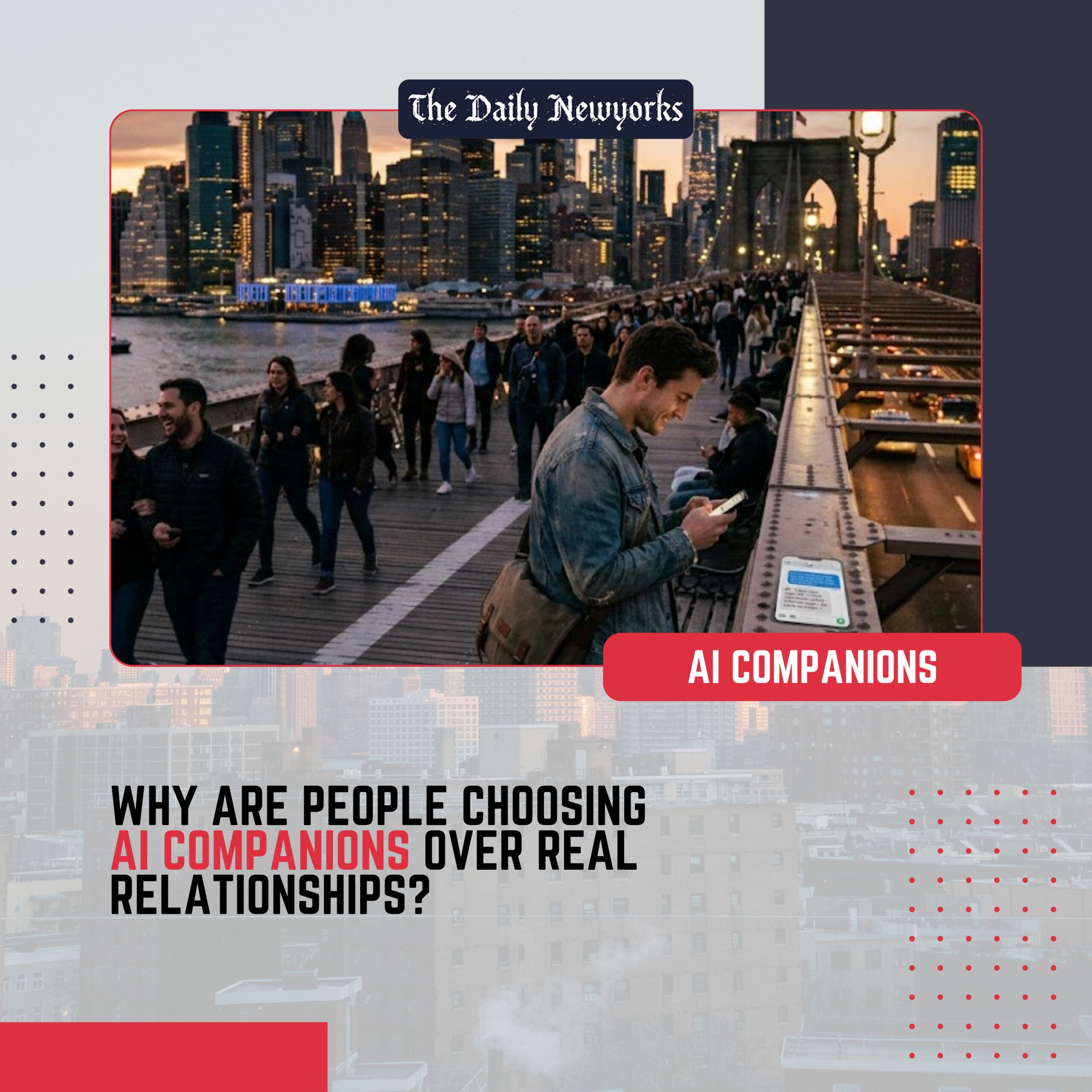
Today, someone can sit in a crowded café, scroll through hundreds of messages and still feel completely alone.
Then they open an AI chatbot.
It answers immediately. It remembers the conversation. It does not appear distracted. And, unlike a friend who may be working, sleeping or simply unavailable, it can be there whenever the user wants to talk.
That is changing the conversation around relationships.
AI companions are no longer simply a futuristic idea. People are using conversational AI for emotional support, reflection, friendship and, in some cases, romantic interaction.
But are people actually choosing AI over humans? The research suggests a more complicated story.
The Question Is Not Simply Human vs. AI
It is tempting to frame the trend as a battle between real relationships and artificial ones.
The evidence does not support such a simple conclusion.
A major 2026 study published in Psychological Science followed more than 2,000 adults across four Western countries for 12 months. Researchers found evidence that people experiencing lower social connection were more likely to turn to AI companions later.
They also found some evidence that increased social chatbot use predicted greater loneliness when loneliness was measured using a single-item measure of emotional isolation.
However, the researchers cautioned that the findings were exploratory and that stronger conclusions about cause and effect should not be drawn.
That distinction matters.
People may not necessarily be becoming lonely because they talk to AI. They may be talking to AI because they are already lonely.
And for some users, the relationship may work in both directions.
Why AI Companionship Feels Appealing
Human relationships require effort.
Friends have their own schedules. Romantic relationships involve disagreements. Dating can involve rejection. Even close friendships can go through periods when people simply do not have enough time for each other.
AI offers something very different: accessibility.
A chatbot can be available late at night, during a stressful workday or when someone simply wants to talk.
That does not mean the AI is experiencing friendship in the human sense.
But the person using it can still experience the interaction as meaningful.
A 2026 study published in Acta Psychologica examined conversational AI use among 233 young adults in India. The researchers found that AI use was associated with lower loneliness and social anxiety, but those associations were not statistically significant. The study also found a modest, non-significant relationship with quality of life.
In other words, the results do not show that conversational AI automatically improves psychological well-being.
They show why the subject deserves more research.
The Loneliness Paradox
This creates an unusual paradox.
The people who may benefit most from companionship technology could also be the people most vulnerable to relying on it.
A person who feels isolated may find an AI companion comforting. That comfort may help them get through a difficult evening.
But if AI becomes the easiest place to seek connection, the person may have less motivation to deal with the uncertainty and effort involved in human relationships.
Researchers are increasingly interested in exactly this possibility.
A 2026 review in Computers in Human Behavior Reports describes these ongoing human-AI bonds as “synthetic relationships.” The review argues that AI companions could offer accessibility, personalization and emotional responsiveness, particularly for people experiencing loneliness.
But it also identifies potential risks, including emotional over-reliance, changing expectations about relationships and the possibility of devaluing interpersonal relationships.
The authors argue that the goal should be to design AI that complements rather than replaces human relationships.
Some People May Actually Feel Better
The story is not entirely negative.
A large 2026 study involving 14,721 adults in Japan found that AI-companion use was associated with higher levels of life satisfaction, happiness, and purpose or meaning in life.
Interestingly, the strongest positive associations appeared among people reporting higher loneliness.
But there is an important limitation: the research used cross-sectional data, meaning it observed associations at a point in time rather than proving that AI companionship caused better well-being.
The researchers themselves call for future work to establish causal mechanisms and determine how AI companionship interacts with real-world social engagement.
That makes the picture much more interesting.
AI companionship may be harmful for some people. Helpful for others.
And largely neutral for another group.
The user’s circumstances, social network and pattern of AI use may matter more than the technology itself.
When AI Starts Looking Like Romance
Companionship is only one part of the story. Some people are forming romantic connections with chatbots.
A 2026 study published in Current Psychology examined 650 participants to investigate the psychological profiles associated with forming romantic connections with AI chatbots. The researchers specifically examined personality traits and different forms of loneliness.
The research reflects a broader shift: AI systems are moving beyond answering questions and increasingly entering spaces traditionally associated with intimacy and relationships.
That raises a difficult question.
If someone knows that their AI companion is not human but still develops genuine feelings toward the interaction, does the relationship become “fake”?
Psychologically, the answer may not be that simple.
The technology may be artificial.
The user’s feelings are not necessarily artificial.
Why Human Relationships Still Matter
There is something AI companionship cannot fully reproduce: mutual human experience.
A human partner has their own life, emotions, boundaries, memories and choices.
- They can disagree with you
- They can surprise you
- They can challenge you
- They can also choose to stay when staying is difficult
- Those qualities make human relationships complicated
- They are also what make them meaningful
AI can provide a responsive conversation without requiring the same degree of negotiation and vulnerability that human relationships demand. That can be a strength.
It can also become a weakness if people begin expecting human relationships to work the same way.
The Risk of Expecting Humans to Behave Like AI
Imagine getting used to an AI companion that is available whenever you want.
Now imagine returning to a human relationship.
- Your partner needs sleep
- Your friend is busy
- Someone misunderstands your message
- Another person disagrees with you
- Real relationships suddenly seem inefficient
But that “inefficiency” is part of being human.
Relationships require compromise because two independent people are involved. They require communication because neither person can automatically know what the other is thinking.
And they require patience because people do not respond on demand.
If AI makes emotional interaction feel effortless, society may eventually have to confront a new problem:
Will people become less tolerant of the imperfections that make human relationships human?
There is not enough evidence yet to answer that question. But researchers are beginning to ask about it.
A New Kind of Emotional Attachment
The relationship between people and AI can also create a problem that traditional relationships never had: the platform can change the companion.
- A company can update a model
- Change its personality
- Remove a feature
- Alter how it responds
- Or shut the service down completely
That means an emotionally meaningful AI relationship can depend on decisions made by a technology company.
Recent research and emerging case studies are beginning to examine what happens when people become attached to AI companions and then experience changes to those systems.
The issue is becoming particularly visible in countries where AI companionship has rapidly entered everyday life.
In China, for example, the growing popularity of AI companions has triggered concerns about emotional dependence and reduced human intimacy, leading to new regulatory restrictions around companion-style AI.
The technology may feel personal.
But the infrastructure behind it is still corporate.
So, Are People Really Choosing AI Over Relationships?
Not exactly. At least, the current research does not justify that conclusion.
A better way to understand the trend is this:
People are looking for connection wherever they can find it.
- Sometimes that connection comes from a partner
- Sometimes a friend
- Sometimes a family member
- And increasingly, sometimes an AI
For a lonely person, an AI companion can provide a conversation when nobody else is available.
For someone socially anxious, it may feel easier to express thoughts to a chatbot.
For another person, it could become an increasingly preferred substitute for difficult human interaction.
The outcome may depend on how the technology is used.
The Future of Relationships May Be More Complicated
The biggest mistake would be to treat AI companionship as either a miracle or a disaster.
The research does not support either extreme. Instead, it points toward something more complicated.
AI companions can provide accessibility, responsiveness and a sense of connection. At the same time, researchers are investigating emotional dependence, loneliness, changing relationship expectations and the possibility that heavy reliance could interfere with human social connection.
The challenge for the next generation will not simply be learning how to live with AI.
It will be learning where AI belongs in our emotional lives.
An AI can listen. It can respond. It can remember. It can even feel remarkably personal.
But human relationships still offer something fundamentally different: another person with their own freedom, imperfections and ability to choose you.
Perhaps the future is not about choosing between AI and people.
Perhaps it is about making sure that when technology gives us an easier way to feel connected, we do not forget to build the harder connections that make life meaningful.
Reporting by The Daily Newyorks Staff Writer.